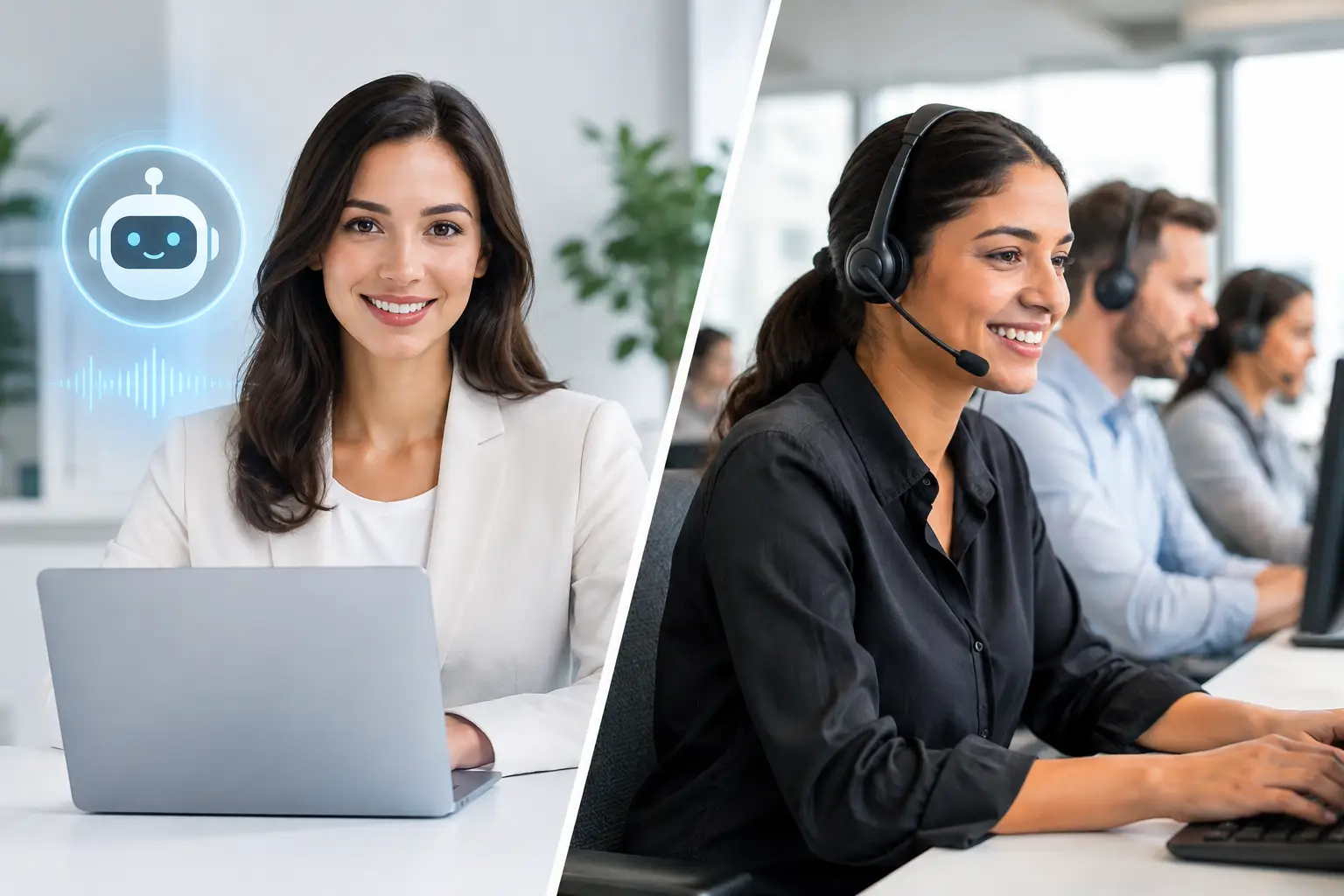
A plumbing office gets a call at 6:12 p.m. A homeowner has water coming through the ceiling and needs help now. If the call goes to voicemail, that job may go to the first competitor who answers. If a live agent takes a message but cannot see the on-call schedule, the customer may still wait for a callback. The AI receptionist versus call center decision comes down to what happens in this moment: Can the caller get a useful answer, a confirmed next step, and the right level of urgency without delay?
For businesses that rely on inbound calls to fill schedules, this is not simply a staffing choice. It is a revenue-protection decision. Both options can extend coverage beyond a front desk team's hours, but they handle context, booking, speed, and scale very differently.
What an AI receptionist and call center actually do
An AI receptionist works from your operating rules
An AI receptionist is a virtual front desk built around the way your business handles calls. It answers calls on your existing number, identifies why the person is calling, asks the right qualifying questions, and follows the instructions you set.
For a home service business, that can mean gathering the service address, understanding the issue, checking whether it is urgent, offering an available appointment, and routing an emergency call to the on-call technician. For a dental office, it can verify whether someone is a new or existing patient, answer basic office questions, find an appropriate appointment type, and book from live calendar availability.
The key difference is that a properly configured AI receptionist does more than take a message. It can act on business-specific information every time it answers. Hours, service areas, pricing policies, frequently asked questions, call-routing rules, calendars, and escalation requirements are part of the call flow.
After the call, the system can send a transcript, summary, lead details, and appointment information to the people or systems that need it. The office begins the next business day with organized follow-up, rather than a list of vague voicemail messages.
A call center relies on human agents and scripts
A call center typically uses live agents to answer on behalf of multiple businesses. This may be an outsourced answering service, a shared agent team, or a dedicated support operation. Agents can provide a human voice, work through unusual conversations, and use judgment when a caller's situation does not fit a standard process.
The quality of the result depends heavily on training, staffing levels, the agent's access to your information, and how often your processes change. Some call centers can schedule appointments and dispatch urgent work. Others primarily take messages and pass them to your team.
That distinction matters. “24/7 answering” sounds valuable, but a caller who needs an available time, an immediate answer, or emergency routing may not be satisfied with “Someone will call you back.” Before choosing a provider, ask exactly what an agent can complete during the call.
AI receptionist versus call center: where the business impact shows up
The clearest difference is consistency. A call center agent may be excellent, but human availability and familiarity vary by shift. Agents need training, may handle calls for many clients, and may have limited access to real-time calendars or internal systems. An AI receptionist follows the same approved call flow at 9 a.m., during the lunch rush, and at 2 a.m.
Speed is the next factor. A caller should not have to navigate a menu, repeat details, or wait for a callback when the answer is already known. An AI receptionist can answer on the first ring, ask focused questions, and move toward an outcome: booked appointment, qualified lead, transferred priority call, or documented request.
Scheduling is often where the difference becomes most visible. A call center that cannot see live availability usually cannot promise a confirmed appointment. It can collect preferred times, but your staff still has to call back, confirm, and sometimes discover that the preferred slot is gone. That creates extra work and leaves room for the lead to choose another business.
With calendar access and defined scheduling rules, an AI receptionist can book the appointment on the call. That is especially useful for HVAC, plumbing, electrical, cleaning, clinics, and real estate teams where fast response affects conversion.
Cost structure also differs. Call centers commonly charge by minute, call volume, agent time, or coverage tier. That can work well for lower call volumes or for businesses that need broad human support. But costs can rise with seasonal spikes, long calls, and after-hours demand.
An AI receptionist is built for high availability without adding a new overnight or weekend shift. It can handle routine inbound volume at the same standard while sending only the calls that need human attention to your team. The goal is not to remove people from the process. It is to stop people from spending their day on repeatable front-desk work while urgent customers wait.
When a call center may be the better choice
A live call center is not automatically the wrong answer. It can be the stronger option when most calls require deep emotional support, complex negotiation, or case-by-case decisions that cannot be defined in advance.
For example, a business dealing with highly sensitive disputes, detailed insurance issues, or extensive product troubleshooting may need a trained human to lead every conversation. A company with a large, constantly changing catalog of exceptions may also find a human agent team more practical, at least until its processes are better documented.
Human coverage can also make sense for a business that receives only a handful of calls each month and mainly wants message-taking. If the phone is not a major source of appointments, service jobs, or sales opportunities, advanced scheduling and lead qualification may not produce enough value to justify a more capable setup.
Even then, look carefully at the caller experience. A human agent is only useful if they can access accurate information and take meaningful action. A friendly message-taking service still leaves your staff with the work of calling back and recovering the opportunity.
Choose based on the calls you need to finish
The best choice is determined less by call volume than by the outcome your callers need before hanging up. Review a week of inbound calls and identify how many should have been resolved without staff intervention.
An AI receptionist is likely a strong fit if your team regularly needs calls to result in appointments, service requests, lead qualification, emergency triage, or routing to the right person. It is also well suited to offices where staff members are often on the phone, with customers, in the field, or unavailable after hours.
A few questions make the decision clearer:
- Can callers book a job, consultation, or appointment without waiting for your team?
- Do urgent calls need different handling from routine requests?
- Are missed calls costing your business real opportunities each week?
- Can your scheduling, CRM, or dispatch process provide the information needed to complete a call?
- Do you have clear rules for what should be answered, booked, transferred, or escalated?
If the answer is yes to most of these questions, the real need is not just call coverage. It is a front desk that can carry work through to the next step.
The strongest setup keeps people available for exceptions
For many small and medium-sized businesses, the practical answer is not AI or people. It is AI for immediate, repeatable call handling and people for the calls that truly require judgment.
An effective setup starts by mapping common call types. New leads may need qualification and booking. Existing customers may need a reschedule or a quick answer about hours. Emergencies may need immediate transfer. Vendor calls, spam, and non-priority requests should not interrupt the office all day.
That map becomes the operating playbook for the receptionist. The more clearly the business defines its services, scheduling boundaries, service areas, and escalation rules, the more reliably calls can be handled. A managed platform such as Voicy helps configure that playbook, test it against real scenarios, and refine it as the business learns what callers need.
The right system should also make the handoff visible. Your team needs call summaries, transcripts, structured lead details, and clear notifications when a priority call comes in. If a customer asks a question the receptionist cannot answer, the system should capture the context so the customer does not have to start over with your staff.
Every missed call creates a small gap between a customer who needs help and a business ready to provide it. Choose the front-desk model that closes that gap while your team is busy doing the work only people can do.